Nightangle
Modular efficiency for humanitarian aid
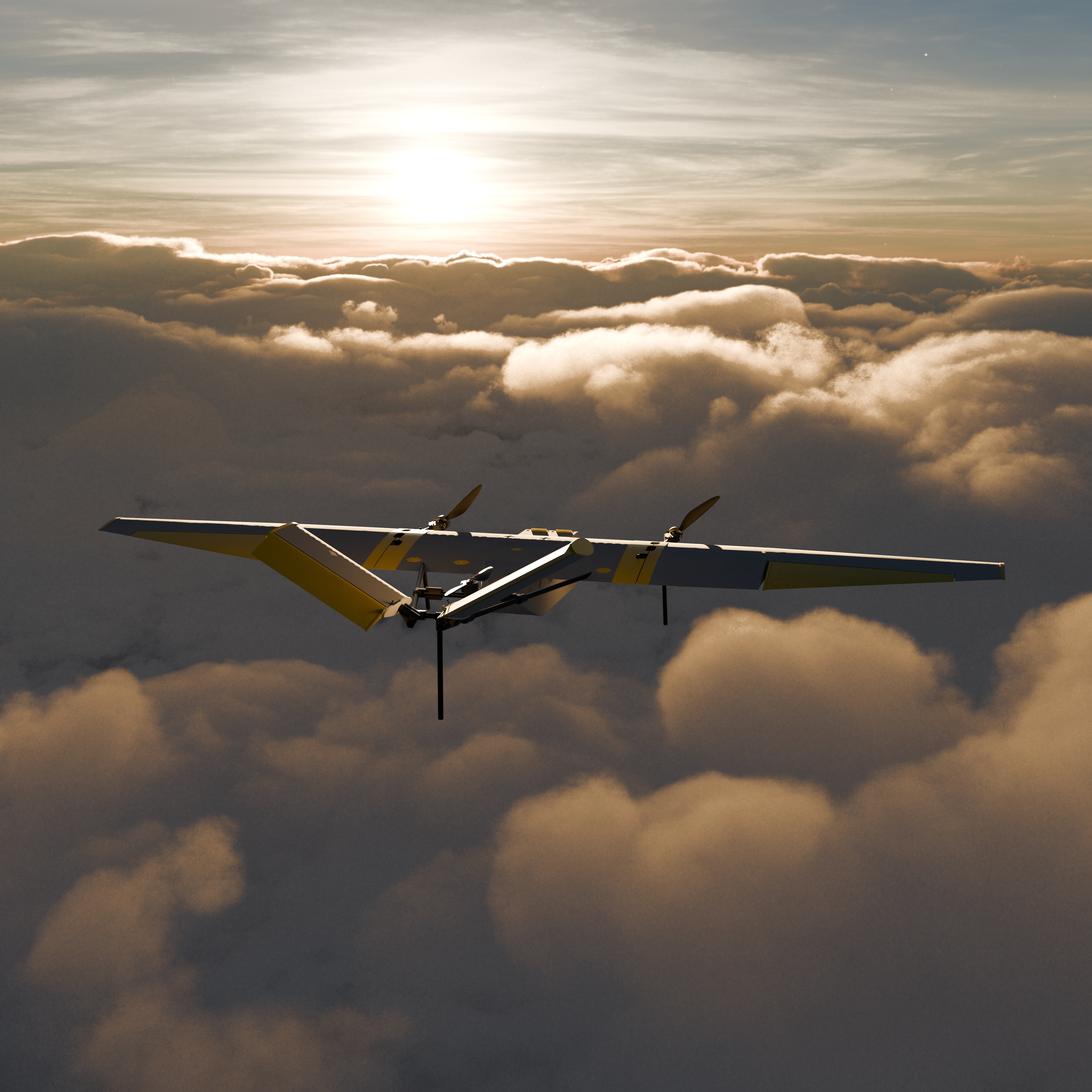
The Nightangle is our 2025 challenger, designed with two main goals aligned with the UAS challenge: increasing aerodynamic efficiency to maximize flight range and rigorous weight reduction.
Key Innovations
- V-Tail Design — Introduced to reduce weight and improve aerodynamic profile, a unique feature among competitors.
- Modular Frame — Features a tool-less assembly system with custom clamps and a new click system, ensuring the drone fits in the competition crate and can be assembled rapidly.
- Carbon Reinforced Parts — Utilization of carbon reinforced filament for 3D printed connections, offering a superior strength-to-weight ratio.
- Optimized Fuseleage — 20% size reduction compared to previous years, significantly reducing drag while housing electronics, batteries, and the 1.5kg humanitarian aid package.
Aerodynamics
To achieve our efficiency goals, we conducted fundamental analysis of atmospheric behavior at our operating altitude of 60m and speed of 55 km/h. Unlike commercial aircraft, the lower Reynolds number regime meant dealing with more turbulent air relative to the airframe size.
Wings
Using XFoil and XFLR5 simulations, we selected an airfoil optimized for high lift-to-drag ratio and stall resistance. The wingspan was maximized to 3.2m within the constraints of the transport box, striking a balance between aerodynamic efficiency and structural weight.
Fuselage
The fuselage was redesigned to be as compact as possible, serving as the central aerodynamic fairing for the payload and avionics. This reduction in frontal area directly contributes to the extended range capabilities of the Nightangle.
Airframe
The “skeleton” of the Nightangle was developed through iterative testing of PVC concepts to find the optimal balance of flexibility and stiffness. The final design integrates the frame structure directly into the wing airfoil thickness constraints.
Assembly
A major focus was the “click system” for assembly. This allows the V-tail and wing sections to be mounted quickly without complex tools, meeting the strict assembly time requirements of the competition while ensuring structural integrity during flight.
Competition Story
Just one week before departure to the IMechE UAS Challenge, Nightangle suffered a crash during final tests due to a loose battery. The team had to rebuild key parts of the drone, with final assembly completed only after arriving in the UK — leaving no time for test flights.
Despite high winds on Thursday that caused other drones to crash or abort, the team waited for Friday — the final day. Going all in with a full mission, DroneTeam Twente achieved its first-ever complete autonomous flight in the UAS Challenge. Nightangle lifted off, transitioned, and completed an entire lap.
During the package release, the tether didn’t snap as intended. With seconds to decide, the team chose to keep going rather than land safely. The tether finally snapped, the package released successfully with no damage to the drone, and Nightangle completed a second lap before landing safely just before the battery ran out.
The result: 8th overall — the best relative placement in DTT history, the highest score for a VTOL in the 2025 Challenge, and the highest cumulative score in team history. The team also took home the Best Design Award (presented by Leonardo) and Best Media & Engagement for the second consecutive year.